
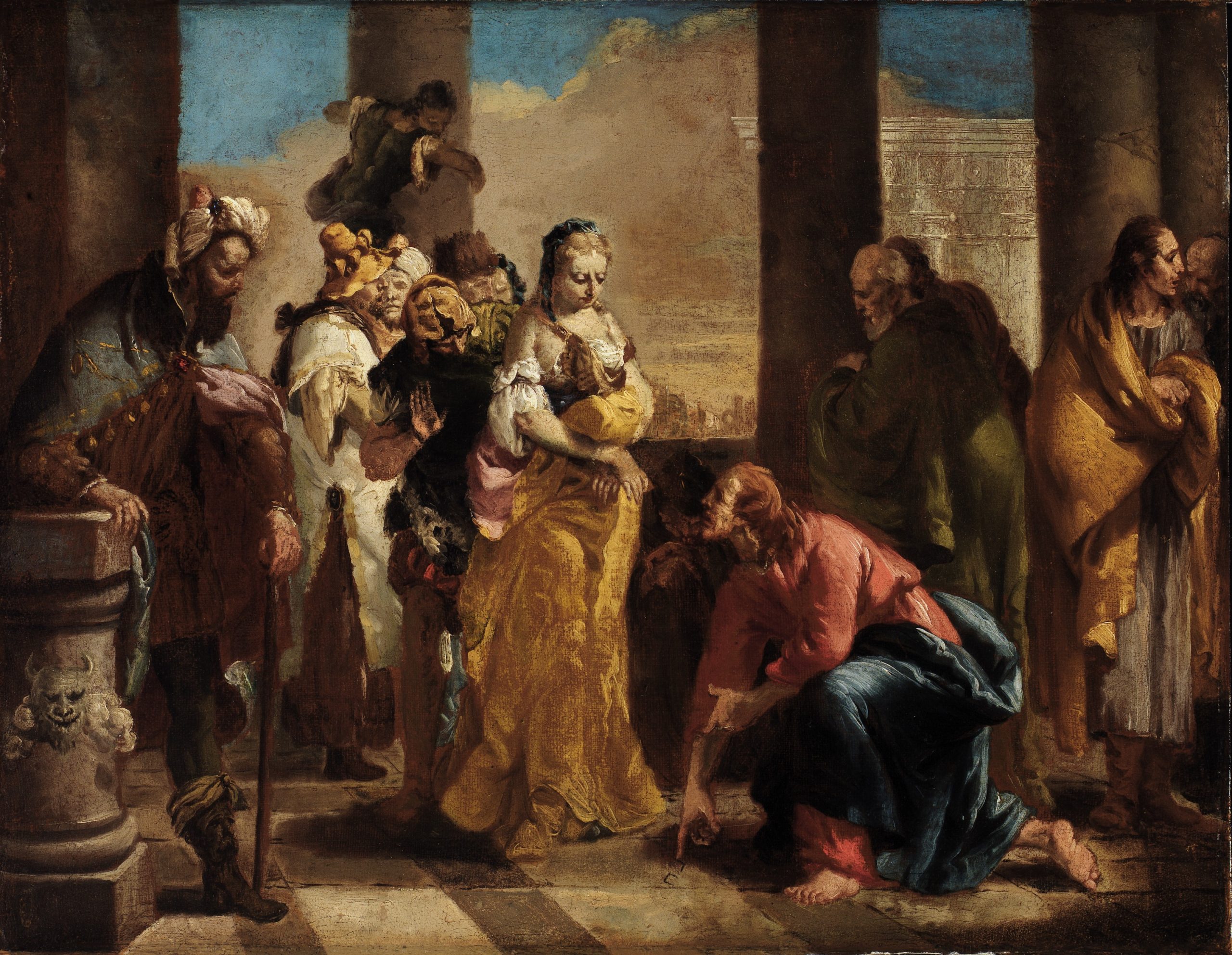
This painting illustrates the events in John 8: 1-11, where the Pharisees pull a woman they accuse of adultery toward Jesus. The text reveals they place her in the middle of the area, which would heighten her shame. They wanted Jesus to weigh in on what the law stated about women caught in adultery, prescribing she be stoned. John 8:6 discloses the Pharisees where attempting to catch Jesus in a trap for the purpose of accusing him for not upholding the law. Jesus's response to the Pharisee's accusations shocks everyone in the vicinity. He quiety bends and writes in the ground with his finger, as the painting shows. His posture is opposite of that of a judge. Scripture does not reveal the message Jesus wrote, but his words surprise them all. "He that is without sin among you, let him first cast a stone at her" (John 8:7). The accusers continue to hound Jesus with questions but he silently returns to writing in the sand. The Pharisees start to leave, oldest first, as they realize they are not righteous enough to judge. The narrative ends with Jesus asking the woman if she has any accusers left. Her voice is heard for the first time during the exchange, "No one, sir" (John 8:11). Jesus offers true grace and mercy, "Then neither do I condemn you. Go now and leave your life of sin."
The painting shows the almost chaotic scene at the temple. There are numerous people having their own conversations throughout the painting. The viewer can almost hear the sounds of the situation. The text explains that Jesus wrote twice on the ground, and this painting seems to paint Jesus either in the middle of writing his message or pointing to it after the fact. His gaze is not on the woman, the person accused and in danger of severe punishment. Jesus is locking eyes with the Pharisees, the ones accusing. They brought the woman to be harshly questioned and judged, but his questioning bypasses her for most of the account. Jesus questions the heart of the accusers. The woman silently gazes at Jesus, unaware that she will not be punished, but released to a new life of obedience.
The painting shows the almost chaotic scene at the temple. There are numerous people having their own conversations throughout the painting. The viewer can almost hear the sounds of the situation. The text explains that Jesus wrote twice on the ground, and this painting seems to paint Jesus either in the middle of writing his message or pointing to it after the fact. His gaze is not on the woman, the person accused and in danger of severe punishment. Jesus is locking eyes with the Pharisees, the ones accusing. They brought the woman to be harshly questioned and judged, but his questioning bypasses her for most of the account. Jesus questions the heart of the accusers. The woman silently gazes at Jesus, unaware that she will not be punished, but released to a new life of obedience.
Title of Art: Woman Taken in Adultery
Subjects: Jesus, woman accused of adultery, her accusers at the temple
Subject Century: 1st century
Artist: Unknown (Italian, follower of Giovanni Battista Tiepolo)
Art Form: Painting
Date of Composition: 18th century
Exhibit Institution: The Smithsonian American Art Museum (not currently on display)
Exhibit Location: Washington D.C.
VM Image #: 0216
Download:
Full View: